Monday, January 17, 2011

Remembering Travel With T-Shirts

When I look back on my travels, I go through my T-shirt collection. Yes, you read that correctly: T-shirts, not photos. Sure, most people love to browse through their photo albums or slide shows on their iPad to reminisce about their vacation. But I have to be a bit different. Sure, I shoot plenty of photos to either accompany my story, as a way of documenting a trip, or as an artistic exercise. But I prefer to collect odd or unique T-shirts from my travels as a way to remember a scenic hiking trail or a restaurant that served the best Key Lime pie. My T-shirts also serve another purpose: When I wear them on my journeys, they become conversation starters.

I recently guest blogged on my favorite sourvenirs, T-shirts from my travels, for Pam MacNaughtan at Spunky Girl Monologues.
continue reading "Remembering Travel With T-Shirts"

Wednesday, January 12, 2011

Miami's Natural Side

Miamians are certainly not ones to sit still. How could they, when year-round warm weather and miles of sand and sea seduce them to play? But vacationing in Miami also often seems synonymous with navigating the club scene that's still colorful at 5 a.m. When I visit, I try to stay at a low-key hotel, the Angler's Boutique Resort, and spend my time at these nature spots that are plenty vibrant:


1. In 415-acre Bill Baggs Cape Florida State Park, four miles of trails course past a subtropical forest of gumbo limbo and pigeon plum trees and mangrove wetlands that once flourished in Florida. You're bound to spy numerous butterfly species and maybe even a rare peregrine falcon.

2. The two-mile Fossilized Reef Trail winds to a unique geological feature -- visible at low tide -- at Crandon Park's Bear Cut Preserve. On the way, you'll likely encounter a variety of birds, from white ibis to cormorants.

3. Just 20 minutes from downtown, Oleta River State Park is a perfect venue for kayaking along the mangrove-lined Oleta River. This is also one of the state's best spots for mountain biking with some 14 miles of interconnecting single track beside waterways where you may spot dolphins or manatee.


4. At the Deering Estate -- once owned by philanthropist Charles Deering -- naturalists lead treks into a tropical forest where you’ll see a Tequesta burial mound from 10,000 years ago, an avocado tree grove from the 1930s, and a solution hole where they found wooly mammoth and campfire evidence from Indians 10,000 years ago. Guides lead numerous other treks, including bird and butterfly walks.

5. Villa Vizcaya, a land of excess owned by Charles's younger brother, the industrialist James Deering, recreated a 16th century Italian villa with rooms filled with European furnishings from the 16th to 19th centuries. The gardens, however, are the highlight of the estate with elements of 17th century French and Italian landscaping. Here you can spend half a day roaming the 10 acres dotted with lily ponds, cascading water, topiary, even a maze garden, and stone grottos.

6. Set on some 83 acres, the Fairchild Tropical Botanic Garden is home to a lush rainforest, the largest such outdoor forest in the continental U.S. More than 200 plants from the Caribbean, South America and Asia can be found on this property, including unique specimens, such as the rainbow eucalyptus with its colored trunk; and the powderpuff tree, candy corn vine and petticoat palm -- you won't wonder how each received its name.

7. You'll have a whole new perspective on plant life after visiting the Fruit and Spice Park. The park is noted for many unique species, including the lipstick tree, which is considered the poor man’s saffron, and the custard apple that has black fleshy fruit. This is a very interactive park where visitors can sniff bay rum leaves, and sample jackfruit, guava, chocolate pudding fruit and sapodilla.
continue reading "Miami's Natural Side"

Friday, December 31, 2010

What I Love About Rio de Janeiro

It's hard not to immediately fall in love with Rio de Janeiro. Of course, like with all kinds of love, it's always unexpected and maybe defies expectations. And that's what happened with my love affair with Rio. When I told all my savvy friends that I was going to this city that's said to epitomize wildness, all I heard was about the dangers that lurked around every corner. "Don't go out alone." "Don't wear any jewelry." "Don't go out at night." These were my farewell warnings from my friends in New York City.

Of course, the news coming out of Rio -- about armed police clearing out drug dealers from a favela (known as a community but what many would call a slum) -- the week I left on my trip didn't help with my expectations of crime. Instead, what I found was a wonderfully artistic, design-focused city, full of warm and welcoming people who went out of their way to be helpful. The neighborhoods of Leblon and Santa Teresa were perfect for walking about and discovering authentic galleries, cafes, restaurants, museums and shops.

Surprisingly, for a city that's noted for it's crowded communities and wall-to-wall chaotic traffic, the city is networked with bicycle lanes and dotted with clusters of lush parks cut by challenging hiking trails, and meticulously landscaped gardens.


Usually when you hear about a city's signature features, they often disappoint when seen up close. They just can't live up to the high expectations. In the case of Rio, Ipanema Beach's wide swath of golden sand, the immense granite Sugarloaf Mountain and the much-revered Christ the Redeemer statue that soars atop Corcovado Mountain are all breathtaking in different ways. And, though I'm not a fan of visiting major tourist attractions, these were all worth viewing because of surprising findings:

* On Morro da Urca, the hill adjacent to Sugarloaf, I hiked through a jungle and discovered families of monkeys.

* Every Sunday, the major road that parallels Ibanema and Copacabana beaches shuts down so that people can walk, bike or blade.

* The 125-foot-high Jesus statue is snuggled at its base by dense forest land that's oh, so hikable and dripping with exotic and native species.

This slide show will give you a glimpse of Rio's beauty and creativity, its ability to stay close to nature even when you're in the midst of all things concrete, and the sense of being alive that pervades all aspects of a city that you can't help but fall in love with.
continue reading "What I Love About Rio de Janeiro"

Monday, December 20, 2010

Non-Touristy New York City Travel Tips

It seems that every time I have a friend visiting me here in New York City, they tell me they can't wait to see the Empire State Building and Times Square. And I promptly groan in dismay. As a native New Yorker, I know there are so many less-visited sights that are ripe with cultural delights. Yet, these rarely seem to make it on many tourists' lists, especially if they only intend to visit the city for less than a week.

Nonetheless, I recently guest blogged for GotSaga on the sights I would recommend to my friends visit when they're in town.

Here are several additional ones that didn't make it on the list and briefly what I love about each. Not all of these are in Manhattan and not all are good for year-round trips. But they've all got unexpected treasures.


* Take a specialized walking tour with Context Travel. Unlike with many walking tour operators, these treks are very small and they are always accompanied by a guide who has a degree or an education in the subject, whether it's architecture, art or cuisine. I took a tour through Little Italy and Chinatown -- where I nibbled on everything from pork buns, five kinds of jerky and Italian cheeses -- and was surprised to visit shops I never knew existed.

* Who doesn't know Central Park? But even some New Yorkers have never visited the gated garden within Central Park known as the Conservatory Garden. Stroll here in the early in the morning during the week and you'll have the landscaped expanse with bronzes and blooming flowers pretty much to yourself.

* I always come away with a wealth of ideas when I visit the Cooper-Hewitt National Design Museum. But if you think this museum simply exhibits oh, so cool objects that benefit the elite, guess again. An exhibition that will soon end in early January, "Why Design Now," displays everything from a solar water purifier for those living in areas with contaminated water to low-cost eye glasses that allow the underserved people of the world to fill their own prescriptions without the need for an eye doctor.

* It sits not even a mile off Manhattan's southern tip but Governor's Island isn't a well-known destination for tourists. It's only open to the public from June to October but I try to get there (by ferry) every chance I can because, after all, how often do you have a car-free island where you can bicycle or walk around the entire circumference that's so close to an urban area? There's something for just about everyone here. History buffs will enjoy strolling around the late 19th century wide-porched houses of Nolan Park and the grander brick buildings along Colonels' Row while art aficionados will want to visit the island when sculptures dot the lawns and paintings hang is some of these houses that once housed officers and their families. I always make sure to buy a double scoop of farm-fresh ice cream from Blue Marble. Then I sit along the shore, enjoy the cool breezes, and gaze at the expansive views of the Statue of Liberty and Lower Manhattan.

* Whether you have or haven't heard of Manhattan's Hell's Kitchen neighborhood on the west side, you should sign up for a 3+-hour walking tour with Rum & Blackbird Tasting Tours. Come with an empty stomach because on A Taste of Hell tour you'll eat plenty of homemade treats, including chorizo tocos, milk shakes and empanadas. Even if you're a New Yorker, you'll enjoy this trip, as I did, because you'll find a historic feature, like the little-known 414 Hotel, that you somehow overlooked.

* Most New Yorkers and just about everyone else know Staten Island for one thing: the ferry that goes back and forth between Lower Manhattan and the island. I fell into that category as well, I must admit. So you can imagine my surprise when I found out that Staten Island is chock full of pristine green spaces, more than any other borough of NYC. I've blogged about this last year. It is well worth visiting Staten Island and either walking, hiking or bicycling along wooded trails, having brunch along a pristine waterfront, wandering a quiet beach and then enjoying a fresh fish lunch.

* It seems NYC has its share of little-visited islands -- as far as tourists go -- and that includes Roosevelt Island that's set in the East River. The tram that easily connects the island with Manhattan just reopened after an extensive renovation, but you can also take a quick subway ride there on the F train but it's nowhere near as scenic. Plenty of people choose to reside on Roosevelt Island because of the sense of community and solitude. This, plus the stunning views of Manhattan are reason enough. But I visit to play tennis, bicycle along a four-mile path, jog along the promenade, picnic at Lighthouse Park, and, take the annual Magnolia Blossom Walk where not only can I relish in one of the first signs of spring but also learn about some of the island's architecturally-interesting landmarks, including the ruins of a smallpox hospital. (The Magnolia Blossom Walk is led by the Roosevelt Island Historical Society.)

continue reading "Non-Touristy New York City Travel Tips"

Wednesday, December 15, 2010

National Park Treasures Without The Crowds

Who wouldn't want to experience the magic of Yellowstone, Yosemite, the Grand Canyon or a host of other national parks? But the first thing that comes to mind for me when I think of visiting these parks in high season is fighting off the crowds.


So what if I told you that it's possible to have all the magic without all the madness? You'd probably think I was delusional. Check out my latest piece for The Huffington Post and you'll see from the accompanying slide show that you don't have to sacrifice scenery for sanity.
continue reading "National Park Treasures Without The Crowds"

Thursday, December 2, 2010

Why I Love Off-Season Travel

I’m a big fan of off-season travel. In fact, you can read my quotes on this topic in today’s ABC News. There are some obvious reasons to hit the road off season: Flights and hotels are much cheaper. For example, I'm planning a trip to the Out Islands of the Bahamas in 2011 and I'll looking to go in May when hotel prices drop significantly.I also visit Vail and other ski areas in the summer when I can stay in at the resorts for a fraction of the cost and go hiking and mountain biking on the slopes.

As far as the crowd issue goes, I travel to Portugal a lot and I love going during the low season when the weather is still mild. And, unlike in the high season, it's easy to get reservations at some of the best restaurants in Lisbon during this time. Another plus of traveling during low season is that you can get more of a feel of authenticity and engage in more mingling with the locals. For example, I visit Reykjavik in December and January when there are only a few hours of daylight. And yet this is a perfect time to hang out in the cozy coffee shops and bars with the locals and chat about politics, the economy, design and art -- topics they love to talk about.

The low season is also a great time to experience local festivals that only occur at that time of the year. For example, in Croatia, the truffle festival in Motovun takes place in November.
continue reading "Why I Love Off-Season Travel"

Wednesday, November 24, 2010

Castle Building in Southern France

How could a volunteer trip that involved helping rebuild a medieval castle turn into a lesson in Zen? That's what happened to me when I journeyed to a town not far from Avignon to spend a week with the group La Sabranenque that's noted for its restoration wook. I just guest blogged about this enlightening experience for Got Saga. They wanted to know about my favorite travel story that I enjoy telling and retelling. This is definitely it.

continue reading "Castle Building in Southern France"

Tuesday, November 23, 2010

Visiting Davos, Switzerland Without Downhill Skiing


Though I downhill ski, when I travel to ski country, I like to find options that don’t lock me in to nothing but a week of high-priced lift tickets, expensive food at mountain resorts and dealing with everything from out of control skiers to long lift lines. Of course, everything is a little different in Europe but, still, I prefer varying my activities when visiting a ski resort.

And that’s what I did when I visited Davos, Switzerland. This is, of course, a mega resort and yet there is plenty to do that has nothing to do with downhill skiing. Here are some of my favorite activities plus additional options:


1. Cross country ski

More than 45 miles of trails beckon, some for those, like me, who prefer classic Nordic skiing, and others for skiers who like to skate. Many trails wander through peaceful valley. And you hardly have to be an expert: there’s a ski school, a place to rent equipment and, even better, the trails are free! Plus, you’ll find a two-mile trail that’s available for night Nordic skiing.


2. Ice skating

I’m not a big fan of indoor skating but, in Davos, you have your choice: If you prefer the relative warmth of an indoor rink, you’ve got it here. But Davos is also home to Europe’s largest natural rink. This is where I skate when I travel to Davos.

3. Hiking

Just because there’s snow on the ground is no reason to stop hiking. And Davos, with it’s well-marked trails, makes it easy to either work up a sweat on a strenuous trail or just enjoy the scenery. When I don’t have a lot of time to get to a trailhead, I walk around Davos Lake. Otherwise, there a lovely 2+ hour easy walk from Ischalp back to Davos that meanders through a dense, snow-coated forest and then along a wide trail to Calavadel with its scenic valley views, finally following a river to Davos.

4. Snowshoeing

I actually prefer Nordic skiing to snowshoeing which I find nowhere near as smooth and rhythmic. That being said, Davos offers some pristine showshoe trails, including those that make a loop from the top of the Pischa cable car station. There you’ll maybe have the well-marked trails to yourself as you wander along sunny slopes. And, of course, like most things in Davos, you can sign up for a 1+ hour showshoe trek by moonlight.

5. Tobogganing

Though I’m not the biggest fan of careening downhill at high speed with no chance of slowing down before hitting the bottom, families love tobogganing here, especially nighttime adventures along the curves of Davos-Schatzalp.

6. Horsedrawn carriage

This is definitely a more mellow alternative that can be perfect for couples who want a romantic ride by moonlight.

7. Wellness & Pleasure Pool Centre

After all these workouts, mellow as many may be, your muscles are bound to become weary. That’s why you’ll want to spend the afternoon at the Wellness Center where you can opt for a hot stone massage or an interesting acupoint massage (it’s based on acupuncture meridiens). You’ll also have your choice of treatments and rooms, like found in the Saunarium and Silent Room, with gorgeous mountain views. A Finnish sauna, foot pools, hydrotherapy pool and cold surge shower are all meant to stimulate your immunity and your circulation.

8. Museums

Davos is not all about action. The town is chock full of cultural activities. Among the museums that I love because I enjoy checking out vintage artifacts include the Winter Sports Museum where you’ll find displays of old ski bindings, sleds and skates; the Toy Museum with its teddy bears, doll houses and other items from a private collection dating from the 18th century; and the Museum of Medicine -- because I have a medical background, I can’t pass this up -- where you’ll find artifacts that make you glad you’re seeing a doctor in the 21st century.

In addition, because I enjoy checking out art, the Kirchner Museum is a must see for those who enjoy this German artist’s colorful landscapes. His work is said to have inspired Expressionism and this museum is the largest collection of his work in the world.

continue reading "Visiting Davos, Switzerland Without Downhill Skiing"

Tuesday, November 9, 2010

Mexico's Day of the Dead Festivities

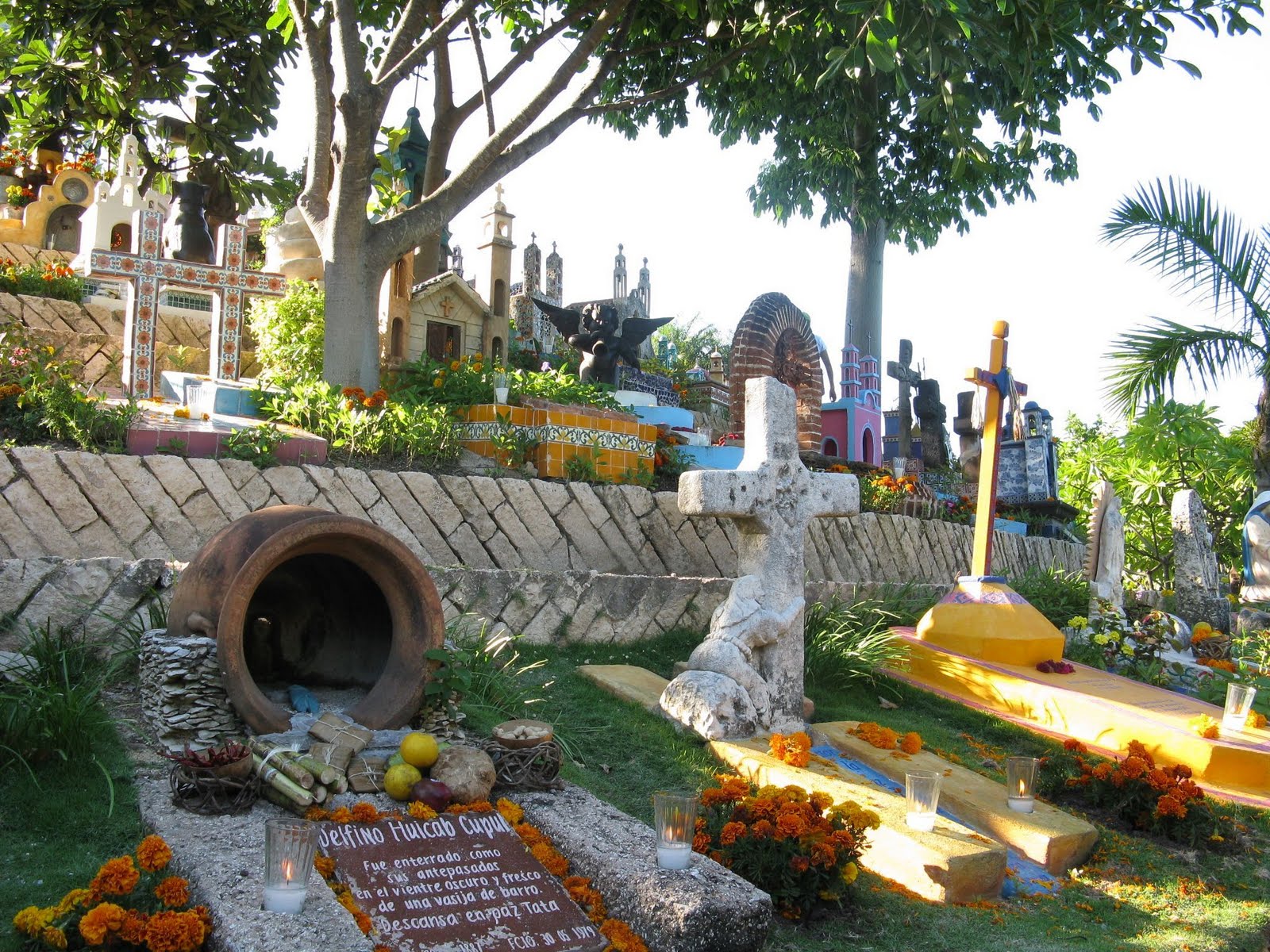
For many of us, it might seem scary to tell stories of the dead to very young children or to allow them to play with skeletons and skulls. But in Mexico during the Day of the Dead festivities,it’s not only perfectly natural and appropriate but these and other activities are a celebration, where everyone spends time remembering their relatives who passed away. They honor them by setting up elaborate altars with items their relative liked when they were alive, whether it’s a favorite food or beverage or other items.

And they add candles, fruit and flowers (the marigold in the flower of the southern part of Mexico) to tempt the dead to pay them a visit.


Recently, I had the opportunity to visit Xcarat, an eco-archeological park in Mexico’s Riviera Maya. And, though at first this sounded like one big amusement-type park -- which I’m not a fan of -- in fact, it’s an entertaining educational experience year-round, but especially during the Day of the Day -- really referred to as Vida y Muerte or Life and Death, which they celebrate from October 30 through November 2.


In the following photos -- most taken at Xcarat and one during a private ceremony in Coba -- you’ll see some of the colorful, lively and life-affirming activities.


This tiered cemetery is set on seven levels representing the seven days of the week and contains 365 faux graves that reflect actual tombs and the amusing epitaphs found all around Mexico. During the Day of the Dead, anyone can place offerings and a photo of their loved one on any of the graves.

Xcaret offers a number of special workshops and displays for children to celebrate the Day of the Dead, and that includes a visit with a very evocative storyteller who goes under the guise of La Catrina, the signature Lady of the Dead, wearing her traditional upper class dress. She tells stories of the dead that captivate children and adults alike (including me).


Another Day of the Dead specialty is mucbi pollo in which a chicken dish that can be prepared different ways is cooked by burying in the ground. I was able to attend a private village ceremony in Coba where I watched the locals prepare the mucbi pollo almost like a chicken pot pie -- they made the pie of corn meal, wrap it in banana leaves and bury it in the ground along with hot coals. The burying is accompanied by music played on traditional percussion and wind instruments. The highlight was when it was uncovered two hours later, accompanied by a shaman who blessed the food and offered it to the spirits.
continue reading "Mexico's Day of the Dead Festivities"