Showing posts with label Americas. Show all posts

Saturday, June 18, 2011

Radio Show: Rio de Janeiro + Its Travel Myths

I'm always amazed to hear how people avoid traveling to Rio de Janeiro because they think it's just ridden with crime. It's certainly curious, for example, that the flight attendants I spoke with on the way down told me to remove every last piece of jewelry I had on -- and I wasn't wearing gold or diamonds, that's for sure -- because well, it's Rio. They also told me to now go bicycling or jogging alone. Oh, and be careful of the traffic, especially at night when you'll encounter drunk drivers. It's a good thing I didn't listen to any of this advice.


You can listen (below) to my recent interview with Pat Boyle on the Travel Show at KPAM 860 radio in Portland, Oregon where I dispel these and other myths associated with this vibrant and welcoming city.

To listen to the show, simply click on the audio player below:


continue reading "Radio Show: Rio de Janeiro + Its Travel Myths"

Sunday, June 5, 2011

Finding an Authentic Bahamas

I've never been a fan of mega beachfront resorts, which line former pristine swaths of sand. To me they represent development gone awry. So when I was planning my trip to the Bahamas, I wanted to steer clear of any chain properties as well as those that featured gambling, water parks and the like. So, I focused my attention on the Out Islands of the Bahamas, which are particularly popular with fishermen and boaters. I finally decided on Long Island because it offered a nice mix of low key activities with plenty of authenticity. (My article and accompanying video slide show on pristine Long Island recently appeared in the Huffington Post.) But I realized that I'd have to overnight in Nassau because of flight scheduling issues. And this is where I was in a predicament, wanting an economical hotel that wasn't far from the airport and yet was laid back and charming.

It looked like these were tough criteria to meet and yet I thought I read about the Orange Hill Beach Inn. Then I started reading TripAdvisor and, curiously, the reviews were more all over the place than usual, with some saying they couldn't wait to return, that the staff couldn't have been friendlier and that it was a true hidden treasure, while others said it was filthy, the staff was rude and that the rooms were overprices. Wow, what a disparity. But, after looking at the expensive, glitzy alternatives, I decided to take the chance and I'm so glad I did.

I stayed two nights, one on each end of my trip to Long Island and I so wish that I had a week, that's how much I adored the Orange Hill Beach Inn. Yes, it's got a rough-around-the-edges feel. But it's also homey, and the staff was warm and welcoming. Yes, it's very low key but the setting, a lush garden expanse with all manner of blooming foliage, can't be beat. It's located literally across the street from a long sandy beach that I found perfect for walking or sunning with little in the way of crowds. My accommodation, which was one of two private cottages, was spacious with a wee kitchen and a small balcony where I sat and enjoyed the view from my mini-hilltop retreat. There's even a tiny man-made waterfall outside my door!

They have a small pool but my favorite activity was sitting in one of several wooden swing chairs amidst the palms, frangipani and other colorful and fragrant foliage. Among the other tropical plants on the property, we found bougainvillea, banana trees, sea grapes and dozens of other with blossoms in myriad hues. In the early morning, it was a delight to get a cup of coffee and sit amongst the foliage listening to the twittering birds, which were in abundance.

At first I thought that the location -- literally a five-minute cab ride from the airport -- would be noise (Not) and that it would be isolated (Not). In fact, the hotel does a daily grocery run giving you the opportunity to buy dinner fixings that you can cook if you're staying in one of the cottages. They can, sometimes, drop you off at a nearby restaurant that's also within walking distance. But, if none of that works for you, there's also a mini bus that runs along the coast that goes to and from downtown.

One of the best things about this inn is the food. They serve three meals but dinner is the real treat. The short menu changes nightly and during my two-night stay, they served chicken or shrimp fajitas, jerk chicken or tuna, grilled grouper, cracked conch, shrimp with pasta, and Bahamian lobster tail. My favorite was the Bahamian combo of chicken, ribs, and grouper fingers.

This is a family-owned business -- Judy, the owner, has had the place for 31 years. And they have a real following with guests returning year after year. In fact, it's not unusual to hang out in the bar, dining room or outside the reception area and find people you met on your previous visit.

So, where did all those bad reviews on TripAdvisor come from? Maybe some guests couldn't deal with some peeling paint, a faucet fixture that wasn't working properly or the shower that didn't heat up very fast. Remember, I said it was rough around the edges. Don't go expecting a palatial retreat. Go expecting to relax and enjoy the low-key Bahamian vibe, eat some tasty food, and maybe make some friends. That's what I did and I can't wait to return next year.
continue reading "Finding an Authentic Bahamas"

Sunday, May 15, 2011

Things You Didn't Know About Rio

How well do you think you know Rio de Janeiro? Do you believe that the city's golden sands are places where you could go topless or au natural? What about all that drinking -- must be plenty of drunk drivers on the roads, especially on Friday and Saturday nights, huh? And, should you want to wake up from your hotel and walk down the street to some of the city's renowned beaches, such as Ipanema and Copacabana, that's going to really cost you several hundred dollars a night, right? Wrong on all accounts.


I came up with eight myths about Rio de Janeiro based on what I've overheard many a traveler discuss. This piece that I wrote for the Huffington Post sorts out fact from fiction.
continue reading "Things You Didn't Know About Rio"

Wednesday, March 9, 2011

Trekking Through Maui

When I visit any of the Hawaiian islands, I rarely spend much time on palm-fringed beaches. Instead, I either lace up my hiking boots and hit the trails or I escape to any of dozens of parks and gardens. These are some of my favorite walks and hikes on Maui.  Because I gravitate to accommodations that have an aura of low-key authenticity, one of my fave accommodations is the Kaanapali Beach Hotel. It's right on the beach, and has some authentic cultural performances as well.


Most people who visit the volcano, Haleakala, do so either by gazing out of their car windows, or from a bicycle seat as they cruise at high speed downhill from the summit. Instead, I tackle some of the many trails that crisscross this landscape with lava cones, lush fern life and ash-laden surfaces. The Sliding Sands Trail, aptly named, given its surface coated with ash and cinder, seems to head into the clouds as you have misty views of the gaping crater. On the Kaloa Point Trail, you'll have staggering views of the Maui coastline.


Once you've reached the crater floor, you're confronted with a barren-scape as you cross rough lava fields. But even here there are portions dappled with shrubs, and wildflower- and fern-spotted meadows. Other botanical species include native Hawaiian blueberries and the red-flowering ohia trees. Not far from the Holua cabins is a long, dark lava tube that you can crawl through – definitely not for the extremely claustrophobic -- but worth checking out.


If I didn't sign up for a trek with Hike Maui, I might very well have ended up with the masses that crowd the ever popular Seven Sacred Pools. Instead, my group hiked in the early morning through a dark bamboo forest to some desolate pools. On the way, we found mango trees, guava orchards, petite waterfalls and swimmable pools without meeting more than a handful of people. The trail was plenty slippery but worth it for the many snacking opportunities: Our guide had us sample tropical almonds, pineapple guava, thimble berries, nectar from yellow ginger and mountain apples. After just two miles, Waimoku Falls cascades more than 400 feet and the tropical amphitheater makes for a perfect secluded picnic where the only sound is the pounding waters.
continue reading "Trekking Through Maui"

Thursday, February 10, 2011

Las Vegas Beyond Gambling

There are plenty of light shows in and around Las Vegas but the ones I prefer have nothing to do with the Strip. Surprisingly, this overdeveloped city has some pristine patches of wilderness just a short drive from erupting the volcanoes and Egyptian pyramids that capture tourist attention along the Strip. Sure, when I’m in town I hit the craps table for one to two hours, making sure I quit while I’m ahead. But I prefer to stay off the Strip -- at the lower-key boutique Rumor Las Vegas that is thankfully free of a casino.

These are three venues where I spend a lot of my time when I’m in Vegas:


1. Just 45 minutes from the spinning roulette wheels is a wilderness area with almost blinding colors, so intense you may wonder if you've stepped on the surface of the sun. At Valley of Fire State Park, light explodes off the red, mauve, vermilion and white-colored sandstone in Nevada's oldest park in stark contrast to the surrounding drab brown foothills. With names like the Beehives, Elephant Rock, Balancing Rock and the Limestone Hoodoos, these otherworldly formations, resembling their names, are arranged almost like a unique sculpture garden. And scattered about are petroglyphs, Indian drawings and geometric symbols, probably from 225 million years ago. Hiking this park is almost like a treasure hunt. On a short trail to Petrified Logs, you'll find wood from ancient forests that had washed down and transformed to glassy stone millions of years ago.


2. Visitors can escape the chaos of Las Vegas by driving under 30 minutes to a serene, unspoiled landscape where towering sandstone formations replace Vegas' concrete canyons. Red Rock Canyon National Conservation Area with its artist's palette of terra cotta blending to rose, tan and alabaster, is ideal for a day getaway. Here, the driver, hiker or cyclist alike can experience sweeping scenery and rolling desert valleys. A one-way 13-mile road circles the canyon's perimeter where fifteen trails take hikers to the foot of rugged hilltops or across sandstone arches and domes. Driving this scenic road, you'll be surrounded by red- and buff-colored cliffs, yucca and Joshua trees and dense stands of pine that wash the mountainsides with hues of green. Easy walks cross flat beds of wildflowers or wander past stands of ponderosa pines. Strenuous hikes involve rock scrambling to waterfalls.


3. Instead of sweating at the craps table watching your supply of chips dwindle, cool off by jumping on a chair lift. At the Las Vegas Ski and Snowboard Resort and Mt. Charleston you can cross-country ski, horseback ride, camp, or hike.


Mt. Charleston is a place where you can get the whole family back to nature with sleigh rides in the winter and wagon rides in the summer. Even when it's sweltering in the valley, you'll find moderate 70° F weather at Mt. Charleston. For those weary of the almost monochromatic desert around Vegas, Mt. Charleston is a welcome change, where you will find dense stands of aspen, foxtail and white pine. There's hiking for all levels, from a thirty-minute walk to waterfalls to a difficult nine-mile climb to the 12,000-foot peak. Gone is the stale smoky air of the casinos, the endless chiming of slot machines and the stream of neon lights. Instead, you'll gaze at wildflowers in grassy meadows, smell the sweet aroma of ponderosa pines and hear the subtle rippling of streams.

continue reading "Las Vegas Beyond Gambling"

Wednesday, January 19, 2011

It's A Green Washington, DC

When I'm in Washington, DC and the lines are building around the all too familiar sights, including the monuments around the National Mall, I head to two of my two favorite museums, which see fewer crowds: the International Spy Museum -- probably because, as a kid, I always wanted to be a spook -- and the National Museum of the American Indian -- because I studied Native American religions in college. At this latter museum, the landscaping is a vital part of the museum, which completely reflects Native American culture and beliefs.

You probably are well aware that I prefer to spend most of my time outdoors, exploring the serene side of cities. These are highlights of green spaces in and around Washington, DC.


1. Just minutes from the Metro, Theodore Roosevelt Island provides the opportunity to walk trails deep into a forest lush with hickory, oak and sycamore. Many hikers comment how this island feels like a vast wilderness, though it's just stretches barely 90 acres.

2. The Mt. Vernon Trail is an 18-mile path that allows you to bike, jog or walk from Theodore Roosevelt Island to Mount Vernon. Paralleling the Potomac River, the trail gives you places to fish and picnic, bird watch in Dyke Marsh Wildlife habitat or rest among white pines in the Lady Bird Johnson Park


3. The unexpected is surely alive at Kenilworth Park & Aquatic Gardens, which is not only a national park but it has the distinction of being the only one devoted to water plants. While so many of the district's wetlands that were long used by the Native Americans have since been obliterated, luckily, in the 19th century, Walter Shaw, a nature lover, bought this land and cultivated water-loving plants. As a result, the land still retains some of its original wetlands that border the Anacostia River. And, carpeting the property is an abundance of water plants, more than 100,000, including rare lotuses and water lilies. But, when wandering about, take the time to walk the short River Trail that runs from the marsh that surrounds the gardens to the river. You'll likely be able to observe blue herons, muskrats and beaver.

4. Dumbarton Oaks Gardens is a welcome retreat from the heat and chaos of downtown D.C. This ten-acre terraced property, a private estate, has plenty of winding paths and walkways past cherry trees, lilacs, dogwood, pools and fountains. What makes this site so unique is it's design: you'll prowl around the property and find different spaces or garden rooms, as they're referred to, that are only visible once you've stepped into each. This effect is achieved by virtue of gates, walls and a plethora of other barriers that make this garden a wealth of surprises.

5. Just five miles from the White House, Rock Creek Park remains as wild, in parts, as in the 1800s. Don't be surprised to see deer in the almost 1,800 acres of fields and ravines and forest lush with dogwood, beech and sassafras. Hikers and walkers enjoy the six-mile Blue Trail that follows the east side of the creek or the equally long Green Trail on the western ridge of the park.

6. The 184-mile Chesapeake & Ohio Canal, aka C & O, towpath is a quiet, shaded path where mules once towed boats carrying coal, timber and tobacco, can be tackled by joggers and cyclists alike. You certainly don't have to do the whole path. In fact, it's quite common to see weekend athletes running or biking a small portion of this trail after work or on a weekend afternoon.

7. A short drive from the Capitol, Great Falls Park is a perfect venue for experienced kayakers who negotiate treacherous rapids as the Potomac speeds over jagged rocks and drops almost 80 feet in one mile. Stretching along the Potomac, the park also provides several hiking trails where walkers scramble over rocks, stop at bluffs for spectacular views of the narrow Mather Gorge, and trek through forests and swamps.

8. More leisurely treks are found at the U.S. National Arboretum, which occupies more than 400,000 acres. Visitors can wander through the Fern Valley on a path along a stream and across a prairie and meadow. An extensive network of trails leads to a garden of dwarf conifers, an elaborate herb garden with 800 kinds of herbs and an Asian collection along the Anacostia River.


After all this walking, jogging, hiking or biking, at the end of a day I prefer to unwind at the chic Hotel Palomar DC, a boutique property that's not only conveniently located near the Metro, but also offers a complementary wine tasting.


continue reading "It's A Green Washington, DC"

Monday, January 17, 2011

Remembering Travel With T-Shirts

When I look back on my travels, I go through my T-shirt collection. Yes, you read that correctly: T-shirts, not photos. Sure, most people love to browse through their photo albums or slide shows on their iPad to reminisce about their vacation. But I have to be a bit different. Sure, I shoot plenty of photos to either accompany my story, as a way of documenting a trip, or as an artistic exercise. But I prefer to collect odd or unique T-shirts from my travels as a way to remember a scenic hiking trail or a restaurant that served the best Key Lime pie. My T-shirts also serve another purpose: When I wear them on my journeys, they become conversation starters.

I recently guest blogged on my favorite sourvenirs, T-shirts from my travels, for Pam MacNaughtan at Spunky Girl Monologues.
continue reading "Remembering Travel With T-Shirts"

Wednesday, January 12, 2011

Miami's Natural Side

Miamians are certainly not ones to sit still. How could they, when year-round warm weather and miles of sand and sea seduce them to play? But vacationing in Miami also often seems synonymous with navigating the club scene that's still colorful at 5 a.m. When I visit, I try to stay at a low-key hotel, the Angler's Boutique Resort, and spend my time at these nature spots that are plenty vibrant:


1. In 415-acre Bill Baggs Cape Florida State Park, four miles of trails course past a subtropical forest of gumbo limbo and pigeon plum trees and mangrove wetlands that once flourished in Florida. You're bound to spy numerous butterfly species and maybe even a rare peregrine falcon.

2. The two-mile Fossilized Reef Trail winds to a unique geological feature -- visible at low tide -- at Crandon Park's Bear Cut Preserve. On the way, you'll likely encounter a variety of birds, from white ibis to cormorants.

3. Just 20 minutes from downtown, Oleta River State Park is a perfect venue for kayaking along the mangrove-lined Oleta River. This is also one of the state's best spots for mountain biking with some 14 miles of interconnecting single track beside waterways where you may spot dolphins or manatee.


4. At the Deering Estate -- once owned by philanthropist Charles Deering -- naturalists lead treks into a tropical forest where you’ll see a Tequesta burial mound from 10,000 years ago, an avocado tree grove from the 1930s, and a solution hole where they found wooly mammoth and campfire evidence from Indians 10,000 years ago. Guides lead numerous other treks, including bird and butterfly walks.

5. Villa Vizcaya, a land of excess owned by Charles's younger brother, the industrialist James Deering, recreated a 16th century Italian villa with rooms filled with European furnishings from the 16th to 19th centuries. The gardens, however, are the highlight of the estate with elements of 17th century French and Italian landscaping. Here you can spend half a day roaming the 10 acres dotted with lily ponds, cascading water, topiary, even a maze garden, and stone grottos.

6. Set on some 83 acres, the Fairchild Tropical Botanic Garden is home to a lush rainforest, the largest such outdoor forest in the continental U.S. More than 200 plants from the Caribbean, South America and Asia can be found on this property, including unique specimens, such as the rainbow eucalyptus with its colored trunk; and the powderpuff tree, candy corn vine and petticoat palm -- you won't wonder how each received its name.

7. You'll have a whole new perspective on plant life after visiting the Fruit and Spice Park. The park is noted for many unique species, including the lipstick tree, which is considered the poor man’s saffron, and the custard apple that has black fleshy fruit. This is a very interactive park where visitors can sniff bay rum leaves, and sample jackfruit, guava, chocolate pudding fruit and sapodilla.
continue reading "Miami's Natural Side"

Friday, December 31, 2010

What I Love About Rio de Janeiro

It's hard not to immediately fall in love with Rio de Janeiro. Of course, like with all kinds of love, it's always unexpected and maybe defies expectations. And that's what happened with my love affair with Rio. When I told all my savvy friends that I was going to this city that's said to epitomize wildness, all I heard was about the dangers that lurked around every corner. "Don't go out alone." "Don't wear any jewelry." "Don't go out at night." These were my farewell warnings from my friends in New York City.

Of course, the news coming out of Rio -- about armed police clearing out drug dealers from a favela (known as a community but what many would call a slum) -- the week I left on my trip didn't help with my expectations of crime. Instead, what I found was a wonderfully artistic, design-focused city, full of warm and welcoming people who went out of their way to be helpful. The neighborhoods of Leblon and Santa Teresa were perfect for walking about and discovering authentic galleries, cafes, restaurants, museums and shops.

Surprisingly, for a city that's noted for it's crowded communities and wall-to-wall chaotic traffic, the city is networked with bicycle lanes and dotted with clusters of lush parks cut by challenging hiking trails, and meticulously landscaped gardens.


Usually when you hear about a city's signature features, they often disappoint when seen up close. They just can't live up to the high expectations. In the case of Rio, Ipanema Beach's wide swath of golden sand, the immense granite Sugarloaf Mountain and the much-revered Christ the Redeemer statue that soars atop Corcovado Mountain are all breathtaking in different ways. And, though I'm not a fan of visiting major tourist attractions, these were all worth viewing because of surprising findings:

* On Morro da Urca, the hill adjacent to Sugarloaf, I hiked through a jungle and discovered families of monkeys.

* Every Sunday, the major road that parallels Ibanema and Copacabana beaches shuts down so that people can walk, bike or blade.

* The 125-foot-high Jesus statue is snuggled at its base by dense forest land that's oh, so hikable and dripping with exotic and native species.

This slide show will give you a glimpse of Rio's beauty and creativity, its ability to stay close to nature even when you're in the midst of all things concrete, and the sense of being alive that pervades all aspects of a city that you can't help but fall in love with.
continue reading "What I Love About Rio de Janeiro"

Monday, December 20, 2010

Non-Touristy New York City Travel Tips

It seems that every time I have a friend visiting me here in New York City, they tell me they can't wait to see the Empire State Building and Times Square. And I promptly groan in dismay. As a native New Yorker, I know there are so many less-visited sights that are ripe with cultural delights. Yet, these rarely seem to make it on many tourists' lists, especially if they only intend to visit the city for less than a week.

Nonetheless, I recently guest blogged for GotSaga on the sights I would recommend to my friends visit when they're in town.

Here are several additional ones that didn't make it on the list and briefly what I love about each. Not all of these are in Manhattan and not all are good for year-round trips. But they've all got unexpected treasures.


* Take a specialized walking tour with Context Travel. Unlike with many walking tour operators, these treks are very small and they are always accompanied by a guide who has a degree or an education in the subject, whether it's architecture, art or cuisine. I took a tour through Little Italy and Chinatown -- where I nibbled on everything from pork buns, five kinds of jerky and Italian cheeses -- and was surprised to visit shops I never knew existed.

* Who doesn't know Central Park? But even some New Yorkers have never visited the gated garden within Central Park known as the Conservatory Garden. Stroll here in the early in the morning during the week and you'll have the landscaped expanse with bronzes and blooming flowers pretty much to yourself.

* I always come away with a wealth of ideas when I visit the Cooper-Hewitt National Design Museum. But if you think this museum simply exhibits oh, so cool objects that benefit the elite, guess again. An exhibition that will soon end in early January, "Why Design Now," displays everything from a solar water purifier for those living in areas with contaminated water to low-cost eye glasses that allow the underserved people of the world to fill their own prescriptions without the need for an eye doctor.

* It sits not even a mile off Manhattan's southern tip but Governor's Island isn't a well-known destination for tourists. It's only open to the public from June to October but I try to get there (by ferry) every chance I can because, after all, how often do you have a car-free island where you can bicycle or walk around the entire circumference that's so close to an urban area? There's something for just about everyone here. History buffs will enjoy strolling around the late 19th century wide-porched houses of Nolan Park and the grander brick buildings along Colonels' Row while art aficionados will want to visit the island when sculptures dot the lawns and paintings hang is some of these houses that once housed officers and their families. I always make sure to buy a double scoop of farm-fresh ice cream from Blue Marble. Then I sit along the shore, enjoy the cool breezes, and gaze at the expansive views of the Statue of Liberty and Lower Manhattan.

* Whether you have or haven't heard of Manhattan's Hell's Kitchen neighborhood on the west side, you should sign up for a 3+-hour walking tour with Rum & Blackbird Tasting Tours. Come with an empty stomach because on A Taste of Hell tour you'll eat plenty of homemade treats, including chorizo tocos, milk shakes and empanadas. Even if you're a New Yorker, you'll enjoy this trip, as I did, because you'll find a historic feature, like the little-known 414 Hotel, that you somehow overlooked.

* Most New Yorkers and just about everyone else know Staten Island for one thing: the ferry that goes back and forth between Lower Manhattan and the island. I fell into that category as well, I must admit. So you can imagine my surprise when I found out that Staten Island is chock full of pristine green spaces, more than any other borough of NYC. I've blogged about this last year. It is well worth visiting Staten Island and either walking, hiking or bicycling along wooded trails, having brunch along a pristine waterfront, wandering a quiet beach and then enjoying a fresh fish lunch.

* It seems NYC has its share of little-visited islands -- as far as tourists go -- and that includes Roosevelt Island that's set in the East River. The tram that easily connects the island with Manhattan just reopened after an extensive renovation, but you can also take a quick subway ride there on the F train but it's nowhere near as scenic. Plenty of people choose to reside on Roosevelt Island because of the sense of community and solitude. This, plus the stunning views of Manhattan are reason enough. But I visit to play tennis, bicycle along a four-mile path, jog along the promenade, picnic at Lighthouse Park, and, take the annual Magnolia Blossom Walk where not only can I relish in one of the first signs of spring but also learn about some of the island's architecturally-interesting landmarks, including the ruins of a smallpox hospital. (The Magnolia Blossom Walk is led by the Roosevelt Island Historical Society.)

continue reading "Non-Touristy New York City Travel Tips"

Wednesday, December 15, 2010

National Park Treasures Without The Crowds

Who wouldn't want to experience the magic of Yellowstone, Yosemite, the Grand Canyon or a host of other national parks? But the first thing that comes to mind for me when I think of visiting these parks in high season is fighting off the crowds.


So what if I told you that it's possible to have all the magic without all the madness? You'd probably think I was delusional. Check out my latest piece for The Huffington Post and you'll see from the accompanying slide show that you don't have to sacrifice scenery for sanity.
continue reading "National Park Treasures Without The Crowds"

Thursday, December 2, 2010

Why I Love Off-Season Travel

I’m a big fan of off-season travel. In fact, you can read my quotes on this topic in today’s ABC News. There are some obvious reasons to hit the road off season: Flights and hotels are much cheaper. For example, I'm planning a trip to the Out Islands of the Bahamas in 2011 and I'll looking to go in May when hotel prices drop significantly.I also visit Vail and other ski areas in the summer when I can stay in at the resorts for a fraction of the cost and go hiking and mountain biking on the slopes.

As far as the crowd issue goes, I travel to Portugal a lot and I love going during the low season when the weather is still mild. And, unlike in the high season, it's easy to get reservations at some of the best restaurants in Lisbon during this time. Another plus of traveling during low season is that you can get more of a feel of authenticity and engage in more mingling with the locals. For example, I visit Reykjavik in December and January when there are only a few hours of daylight. And yet this is a perfect time to hang out in the cozy coffee shops and bars with the locals and chat about politics, the economy, design and art -- topics they love to talk about.

The low season is also a great time to experience local festivals that only occur at that time of the year. For example, in Croatia, the truffle festival in Motovun takes place in November.
continue reading "Why I Love Off-Season Travel"

Tuesday, November 9, 2010

Mexico's Day of the Dead Festivities

For many of us, it might seem scary to tell stories of the dead to very young children or to allow them to play with skeletons and skulls. But in Mexico during the Day of the Dead festivities,it’s not only perfectly natural and appropriate but these and other activities are a celebration, where everyone spends time remembering their relatives who passed away. They honor them by setting up elaborate altars with items their relative liked when they were alive, whether it’s a favorite food or beverage or other items.

And they add candles, fruit and flowers (the marigold in the flower of the southern part of Mexico) to tempt the dead to pay them a visit.


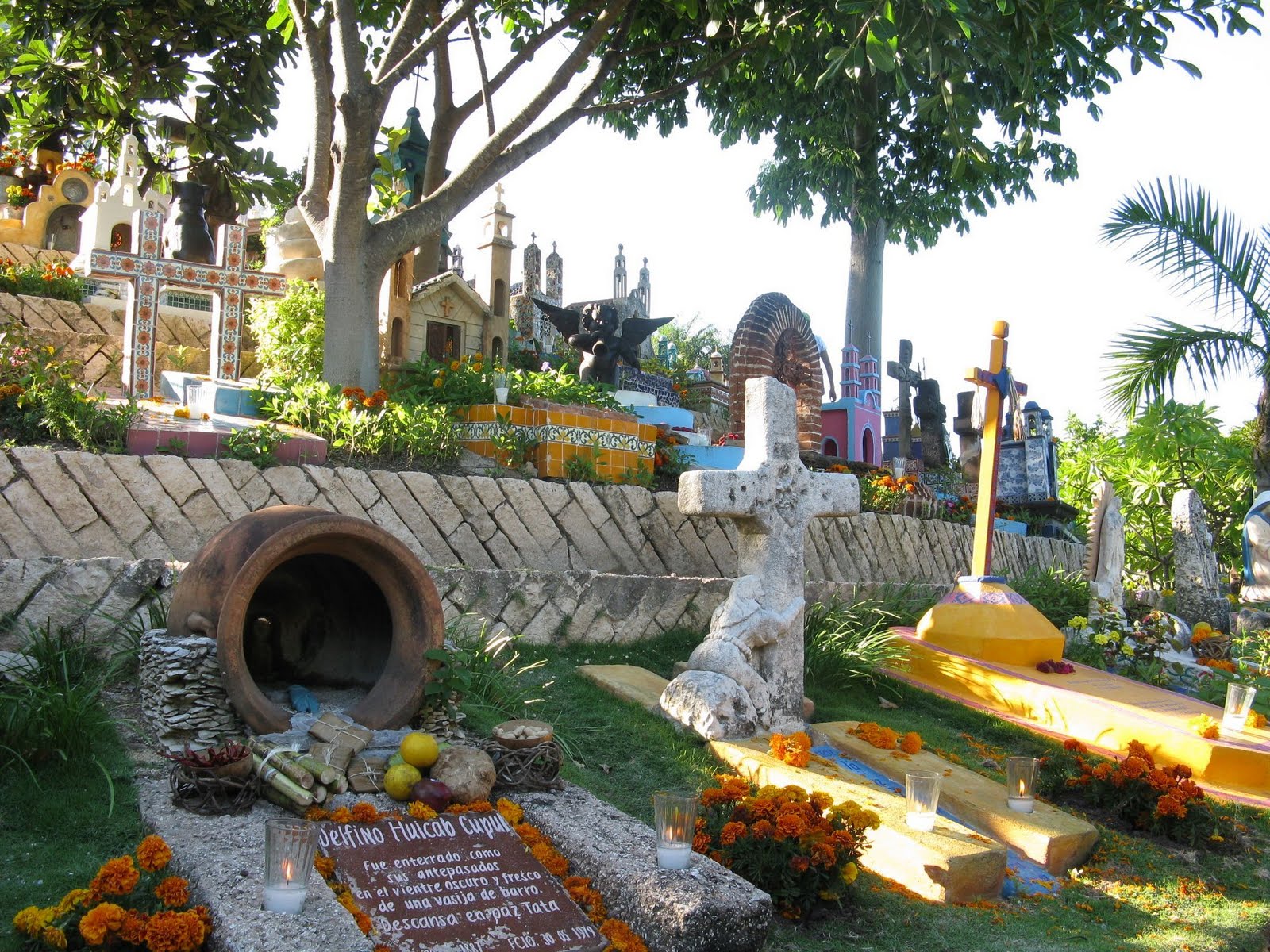
Recently, I had the opportunity to visit Xcarat, an eco-archeological park in Mexico’s Riviera Maya. And, though at first this sounded like one big amusement-type park -- which I’m not a fan of -- in fact, it’s an entertaining educational experience year-round, but especially during the Day of the Day -- really referred to as Vida y Muerte or Life and Death, which they celebrate from October 30 through November 2.


In the following photos -- most taken at Xcarat and one during a private ceremony in Coba -- you’ll see some of the colorful, lively and life-affirming activities.


This tiered cemetery is set on seven levels representing the seven days of the week and contains 365 faux graves that reflect actual tombs and the amusing epitaphs found all around Mexico. During the Day of the Dead, anyone can place offerings and a photo of their loved one on any of the graves.

Xcaret offers a number of special workshops and displays for children to celebrate the Day of the Dead, and that includes a visit with a very evocative storyteller who goes under the guise of La Catrina, the signature Lady of the Dead, wearing her traditional upper class dress. She tells stories of the dead that captivate children and adults alike (including me).


Another Day of the Dead specialty is mucbi pollo in which a chicken dish that can be prepared different ways is cooked by burying in the ground. I was able to attend a private village ceremony in Coba where I watched the locals prepare the mucbi pollo almost like a chicken pot pie -- they made the pie of corn meal, wrap it in banana leaves and bury it in the ground along with hot coals. The burying is accompanied by music played on traditional percussion and wind instruments. The highlight was when it was uncovered two hours later, accompanied by a shaman who blessed the food and offered it to the spirits.
continue reading "Mexico's Day of the Dead Festivities"

Sunday, October 10, 2010

More Hideaway Parks in New York City

Finding hidden parks and gardens is one of my favorite past times when I'm traveling. But there are plenty of out of the way greenspaces in my own backyard. I'm blogged about some of these parks and gardens before. But recently I was asked to guest blog about some additional secret green New York City hideaways, in addition to elaborating on one of my favorite: GreenAcre Park that's smack in the middle of Midtown.

Verdant foliage can appear in the unlikeliest of places in Manhattan, including in the atrium of a skyscraper or in the narrow alley between two brownstones. Exploring New York City slowly on foot is the way to find the attractions beyond most guidebooks.

continue reading "More Hideaway Parks in New York City"

Thursday, September 9, 2010

Travel Tips for Island Escapes + Healthy Travel

Over the past four weeks I've been unusually busy, not only traveling in Malta (I've blogged about my adventures on the island of Comino and will be posting about my travels on the big island of Malta in a couple of weeks) but also writing guest posts for some fellow bloggers. Each one of these posts, like my own blog, deals with either hidden treasures or key travel tips. I want to share these with you:

1. I'm a big fan of island travel, especially when I can find lands that radiate authenticity. In this guest post you'll find out why I especially adore Sardinia, Corsica, the Azores, Bozcaada and the Lofotens. Because I believe in checking out the landscape slowly, on some, I bicycled past vineyards, sandy beaches or small fishing villages while on others I hiked and walked through a lush, wild landscape.


2. So much of the Caribbean is hardly off the beaten track, especially the U.S. Virgin Islands. However, when I visit my favorite island, St. John, instead of sunning on a stretch of golden sand, I take to the hiking trails far from the madding crowds. Here's what I found along these dirt paths that network this island that's mostly preserved as a national park.


3. A trip just isn't enjoyable when you're sick or in pain. Which is why I carry a very organized and extremely complete first-aid kit. Because I also have a medical background, I've devised a first-aid kit that takes care of just about any malady that might hit you on the road, whether you're doing a weekend at the beach or traveling far afield. In this post, I've described in details everything I carry in my first-aid kit. Some may think it's overkill, yet my kit packs small. And, it fits along with my "always be prepared for anything" mentality.
continue reading "Travel Tips for Island Escapes + Healthy Travel"

Monday, August 9, 2010

A Little Bit of Portugal in New York City

It's not often that I step into a restaurant in New York City and find that after the first bite, I feel transported to another country. But that’s what happened to me the other night when I had dinner at a very recently renovated restaurant on the Lower East Side.

Nomad, a restaurant specializing in North African cuisine, still retains a North African theme with its murals, lamps, naturally-sculpted rose stone pieces and other embellishments. But now that it has Portuguese chef, Luisa Fernandes, as its executive chef, the restaurant has taken on a whole new life.


Luisa conjures up some magical Mediterranean fare that include elements from Spain, Italy, Greece, France, North Africa, and her native, Portugal. Portugal is one of my specialties and every dish that came out of the kitchen harkened back to my travels across that country. But each also had a little twist that made it approachable to the American palate.

The fresh sardines came topped with pickled onions. Perfected grilled baby octopus was nestled in amongst chickpeas that were nicely flavored with bits of lamb sausage. A stuffed quail was dressed with a tangy pomegranate sauce and served with couscous, onions and raisins.

I ordered a balanced Trajadura wine from Monho, Portugal to accompany the meal. And I couldn’t get enough of the freshly-baked garlic and herb flatbread. (Many of the dishes are cooked in the brand new wood burning brick oven set into the wall in the dining room. And it’s the maple and cherry woods Luisa uses here that lend to the aromatic flavors.)

The interior of the restaurant couldn’t be more romantic, with flickering candles and a soon-to-open garden courtyard.

If you want to dine in a restaurant where the chef -- who, by the way, was the 2009 champion on the Food Network's cooking competition show, Chopped -- has a supreme passion for cooking, then I’d run right down to Nomad if you live in New York. And, if you don’t, I’d put it on my list of places to dine when you're next in town.
continue reading "A Little Bit of Portugal in New York City"

Sunday, July 18, 2010

Florida's Hidden Retreat

It's hard to believe that there are still hidden corners in Florida, a state I've criss crossed extensively. Yet, I just returned from Cedar Key that harks back to the Florida of maybe 50 years ago. But what was even more curious was that every single person I spoke with before my trip thought Cedar Key was part of the Florida Keys on the east coast. In fact, Cedar Key is on the west coast -- so, clearly, not part of the Keys. And given that there are no water parks, or beach resorts, and that it's one hour from Gainesville or two hours from Tampa, it's understandable why Cedar Key is off the radar.


The island of Cedar Key is one of 17 barrier islands, many of which are part of the pristine Cedar Keys National Wildlife Refuge.


Here's what I found and did:

1. Cedar Key is the farmed clam capital of the U.S. We enjoyed healthy, plump and juicy clams served in myriad ways


2. Kayaking along shallow salt marshes and marine estuaries


3. Plenty of bird watching possibilities, including shore birds like ibis, heron and egret


4. Bold sunsets that I never tired of watching


5. Roads where I rarely saw cars, making it perfect for renting a bike and pedaling around to the museums, old cemetery, petite landing strip and across the bridges linking four of the isles


6. Several state reserves, like the Cedar Key Scrub State Reserve, where I could walk sandy trails bordered by lush foliage and spy curious animal tracks


7. Wandering the town of Cedar Key to check out the arts and crafts shops where I talked with painters and sculptors


8. Taking a historic walking tour of the town that's dotted with buildings dating to the 19th century


My base for this five-day trip was the Cedar Key Bed & Breakfast, a yellow pine, two story 19th century dwelling just steps from the water. Here I knew I had just stepped into another world when owner Alice Phillips greeted me saying "We don't lock our doors here." To a native New Yorker, this couldn't have sounded more alien. But every night we found the door to the inn's public rooms unlocked. There we could raid the ever-present cookie jar for chocolate chip or oatmeal raisin cookies, M & Ms, or biscotti.


The town is oh, so walkable. So at night, we'd wander from dinner down the streets where everything shuts down at 9:30 pm to find our inn along a dark residential lane rimmed in tiny lights. What a welcome sight.

My room, the Honeymoon Cottage, one of the 7 rooms and 2 suites at this B & B -- was plenty quaint and comfy with thick bathrobes, a clawfoot tub, rose detailing, lace curtains and antique accoutrements.

But the key selling point of this room is the views of the garden with the 500-year-old live oak tree. As a New Yorker where views of nature are in short supply, I couldn't get enough of this one.


The backyard garden is where I spent much of my down time listening to the tinkling water fountain or watching the butterflies flitting about the blooming flowers. I often curled up with a book on the patio that fronts the backyard. And, despite the fact that the area drips with heat and humidity in the summer -- conditions I happen to love -- the patio was comfortable with its fans blowing a cooling breeze.

Every morning we were treated to fresh fruit salad, cinnamon raisin toast and bagels, yogurt and an ever-changing hot breakfast. The cream cheese omelet with chives was plenty flavorful. So was the French toast with nutmeg, and breakfast burrito with bacon and cheese. My favorite: the light-as-clouds pancakes. (I have a thing for pancakes that float off the plate; and these were so fluffy that I could've tied them down.)

The breakfast room, like the rest of the inn and Cedar Key in general, was like stepping back in time. An antique type phone and clock hung on the walls as did a framed set of the well-known Donax brushes that were made from local saw palmetto plants.

Alice and Bill, her husband and co-owner, keep a wall of DVDs, CDs and books to occupy anyone who can't find enough to do in and around the islands.

I spent five days here and I could've easily have spent another five or more. It's not every day that you find a warm, friendly place where the owners take such great care in providing their guests with everything they need for an enjoyable stay. They knew I'm very type A and I wanted to know everything there was to do and see and they didn't disappoint. They gave me the insider info on the best restaurant to eat chowder and who serves the best Key lime pie. They suggested who I should kayak with because I'm a novice kayaker as well as who gives one of the best boat tours in the area.


But even more important were the other guests who checked into the Cedar Key B & B. I rarely hold long conversations with guests at breakfast. But here I found people who were smart, interesting and welcoming who had a love of nature. And many of them had either been here before or, if not, they knew they'd return again. And I'll be one of them, too.
continue reading "Florida's Hidden Retreat"

Wednesday, May 26, 2010

Panama Beyond the Canal

For many people, a trip to Panama City isn't complete without visiting the Canal. Having transited the Canal and blogged about learning about its inner workings, I would agree. But I found in my Panama City wanderings, I also found that there were many green spaces as well as other gems that had nothing to do with the Canal. The green spaces, in particular, seemed little visited. Which is one reason why I sought them out. I recently wrote a piece on Eight Cool Things to do in Panama City for GoNOMAD that involve walking, biking or hiking or present interesting cultural offerings. You'll find out where you can roam around the ruins of old Panama City, rent a bicycle to peddle along a car-free waterside lane, or hike through an urban jungle with plenty of bird watching opportunities.
continue reading "Panama Beyond the Canal"

Monday, May 3, 2010

Touring Civil Rights Sites

The 1950s and 1960s aren't so distant in our history as a nation. But when I recently told some colleagues that I was visiting civil rights national parks down south, they had no idea what I was talking about. After all, they asked, what do national parks have to do with civil rights? The National Park Service not only protects the grand scenic vistas that we typically associate them with, but also sites that need to be preserved because they are key in our American identity. And the civil rights sites in Atlanta and Alabama fall into this category. Here is what I found:

1. You could easily spend the day at the Martin Luther King Historic Site in downtown Atlanta. Probably, one of the most memorable parts of the visit was listening to his speeches in the half-hour video in the Visitor's Center as well as standing not far from the original mule-drawn wagon that transported his casket during the funeral. From there, you can gaze all the way to the King Center across the street where his tomb and that of his wife, Coretta Scott King, sit side by side above a reflecting pool.

The site also has a petite rose garden where you can see peace poems written by children. Make sure you have time to tour the adjacent preservation district in this neighborhood, Sweet Auburn that was once home to a very well-to-do African American population. One of the Queen Anne style houses is the birth home of MLK -- it's definitely worth making a reservation for the visit. You'll be able to roam from room to room and hear stories of what board games MLK liked to play in the living room -- it was Monopoly; learn that adults and children sat and talked together at meal time, something that was unusual at that time; and see MLK's favorite room, the kitchen, where he would sit and eat his grandmother's home cooking.


2. Anyone who loves airplanes will delight in the Tuskegee Airmen National Historic Site that honors the all-Black squadrons of Airmen who were active in World War II. At this time, only Hangar 1 is open, but there's a wealth of artifacts here to keep you occupied. And this place isn't just for adults. Kids will enjoy trying to fold a silk parachute into a pack.

There are plenty of audio displays to listen to, mostly of Airmen or their instructors -- something that really makes the place come alive. You'll hear how the instructors put the men through a closet cockpit flight simulator so that they could learn to fly by instruments only. As one instructor said, "I can introduce rough air and make him pretty miserable...You can crack that thing and he [pilot] just steps out."

3. The Selma to Montgomery National Historic Trail runs from Montgomery, Alabama to Selma with plenty of civil rights sites in both cities as well as a museum (The Lowndes County Voting Rights Trail Interpretive Center) in the middle and signs to other sites along the way. The 54-mile trail honors the African-Americans who sought their civil rights and, after two unsuccessful tries -- the first being the infamous Bloody Sunday -- finally made it to Montgomery to present their grievances to Governor George Wallace. Montgomery makes a good stop-over city to do the entire trail. And though the trail can be done in a day, to truly get the most out of it, you should spend a day doing all the sights just in Montgomery, and reserve an additional day to doing the Interpretive Center and the sites in Selma.


The woman who's most emblematic of civil rights movement may very well be Rosa Parks, who refused to give up her seat to a white person on a Montgomery bus. And, though most of us may think we know the story, the museum that pays tribute to her is a must-see. Not only does it provide a dramatic re-enactment of the bus incident that puts you right there, but the rest of the museum provides plenty of details that I know I didn't learn in high school history class. These include how, once Rosa Parks was arrested, the people had only 4 days to print off flyers to mobilize their people for the Montgomery Bus Boycott. (And it's wasn't done by xeroxing, either, but by mimeograph machines.)

Another stop that's mandatory is the Dexter Parsonage , the house where MLK and his wife lived when he was pastor of the Dexter Avenue King Memorial Baptist Church in Montgomery. You have to make a reservation but, again, the visit is memorable, especially because of the guide, Shirley Cherry, who knows plenty of what went on in this house, including on the porch where you can still see the damage from the bomb that exploded while Dr. King's wife and baby were in the house.

After all of these museums, you may think why visit yet another one: the Voting Rights Trail Interpretive Center. That would be a mistake. Again, a wealth of information awaits, with plenty of surprises. For example, the video here is extremely emotional as it provides interviews with actual participants of the marches. And I learned that the center is on land where many African-Americans were forced to camp because they were thrown out of their houses after they had registered to vote. The exhibits provide artifacts from the marches, including photos of Bloody Sunday. Outside you can walk a short loop where signage explains the spot where the marchers passed and what the harsh reality of daily life in the tent was like.

On the south side of the Edmund Petus Bridge that leads into Selma and where the state troopers and sheriff's deputies waited to assail the marchers with tear gas and batons, you'll find the new location for the National Voting Rights Museum. Yes, another museum and another must visit in my book because there is no redundancy among all these venues. They all add to the story. Here you'll see actual quotes written on the wall from participants as well as some of the threatening utterances from the troopers. You'll also find shoe prints from the foot soldiers, the marchers themselves, who were by far, not the leaders; they were the ordinary people that were firm in their commitment to the cause for equality.
continue reading "Touring Civil Rights Sites"

Thursday, January 28, 2010

Oahu: My Favorite Walking Spots

Sure visitors flock to Oahu for its golden crescents of sand and it's surf-centered sports. But whenever I'm on the island, I don my walking or hiking shoes to explore some of my favorite parks and gardens.


I didn't run into anyone at Ka'ena Point, the western most point of Oahu that's accessible only by foot or mountain bike. This wind-swept expanse of dunes and tiny beaches is an albatross nesting site where, on my several visited, I spied monk seals, dolphins, whales, and green sea turtles.


Not far from Diamond Head, the Koko Crater Botanical Garden is lush with sweet-smelling plumeria trees. In this 200-acre arid garden that's set in two craters, I again was one of only few visitors. This time I was mesmerized by the towering crater walls.


At Makapuu Point, I walked a road to the lighthouse that hugs a lava cliff where I had panoramic views of the Koko Crater and Molokai. I even spotted some whales in the open ocean as I took the unofficial cliff trail to the bottom.


It's easy to spend the whole day in Hoomaluhia Botanical Gardens, which is blessed with 400 verdant acres laden with heliconia and other sweet-smelling blossoms and other plants from around the world. I strolled the more than half dozen different trails that wander through a landscape rimmed with sheer-walled cliffs and the ocean beyond. This garden couldn't be a more perfect place to lay out the beach blanket and chill.


I knew it was impossible to walk the entire 700+ acres of the leafy Senator Fong's Plantation Gardens. Luckily, they provide a narrated tram tour as well as guided nature walks through a small portion of this green space. Here, I learned how kukio nut trees are used to make hair conditions; ti leaves are considered good luck; mango is related to poison ivy; queen ginger can grow to 10 feet tall and a rose apple smells like a rose and tastes like an apricot.


continue reading "Oahu: My Favorite Walking Spots"